
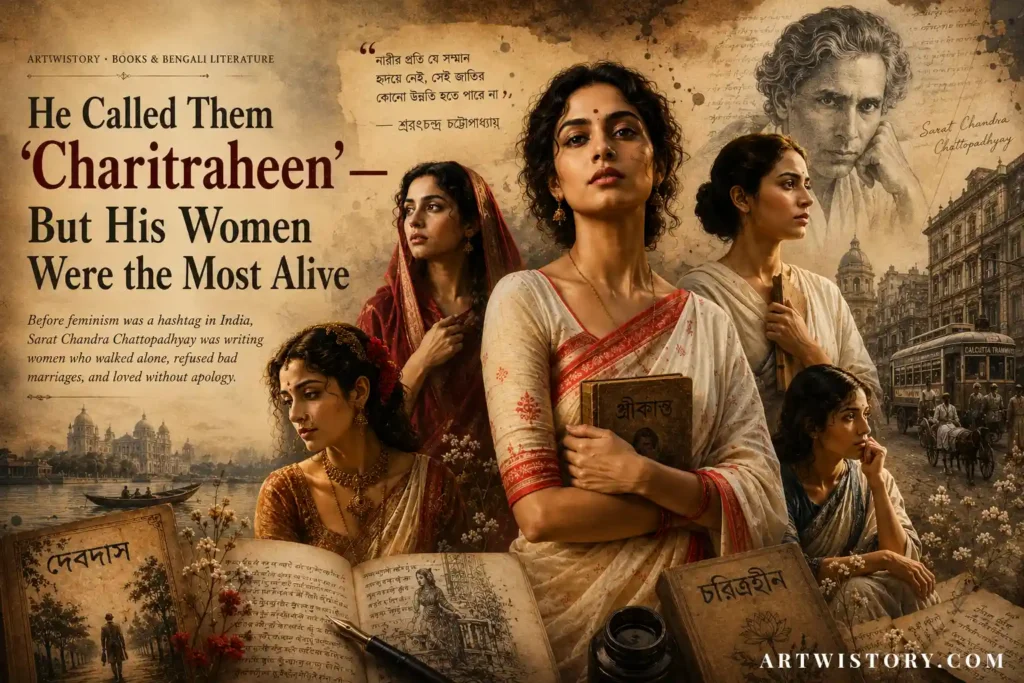
It is fascinating that Sarat Chandra Chattopadhyay is considered the most widely read Bengali writer because he is known as a “writer of fallen women,” and his novels were secretly circulated, with people worried about being caught reading about his “immoral” characters. Yet he is one of the most popular writers, even compared to Tagore, according to novelist Shankar. So, what was Sarat Chandra’s scandal? He dared to write realistic female characters.
This was the colonial era, when women stayed within four walls; child marriages took place, and widows did not have any existence. Against this background came Paro, the fearless girl who fell in love and broke her heart. Chandramukhi, the prostitute who loved with dignity and nobility more than any marriage. Abhaya, who bravely walked out of her marriage despite the abuse, without shedding a tear of sorrow. Kironmayi, who confessed after her husband’s death that she had never loved him. And Kamal, who called marriage a morgue in 1931.
These women didn’t fight with slogans. They just existed, fully, which was the most radical thing they could have done.
“My father did not leave behind anything except self-belief to protect me from the pity of others. That alone has sufficed me to sustain my life. — Kamal, Shesh Prashna (1931)”
A Man Who Looked at Women and Actually Saw Them
The author Sarat Chandra was born poor and amidst chaos. The father of Sarat Chandra had dreams of writing, but would never complete his tales. His childhood life revolved around shifting from town to town, having to live different kinds of lives. He watched the women in his environment: his mother, his neighbors, and women forgotten in society whose lives he witnessed. He saw something which made him stay.
Sarat Chandra cannot be termed as a feminist according to any formal definition. He had never declared himself one. When the public reacted negatively to his novel Shesh Prashna, he quietly wrote in reply that “I do not have any other ulterior motive to bring about social reforms. All I write are stories. Nothing else.” However, what the author did, page by page, book after book, was narrate the world of the inner woman and her desires, the shame which society imposed on her and her defiance of it, among other aspects.
Sarat Chandra considered humanity above chastity, unlike other writers of his time.
Five Women Who Changed Bengali Literature
DEVDAS · 1917
Paro: The One Who Lived and Suffered for Her Love
Parvati, a girl from next door. She fell deeply in love with Devdas in an age where it was important for women to hide everything; that was her sin. Although her family tried to pull them apart, Paro did not collapse. She married another man, built a home, and gained respectability. The misfortune of Paro is not that she lost Devdas. Paro’s misfortune is that the one she loved chose to destroy himself rather than fight for her and lived the rest of his life in unrequited love.
She didn’t forget him, but she didn’t stop living either. It is this combination that gives her the moral strength of a character in a story about someone else.
DEVDAS · 1917
Chandramukhi – The Prostitute Who Bowed to Nothing But Love
This is what Sarat Chandra knew and most of his contemporaries didn’t: The occupation of a woman doesn’t define her essence. Chandramukhi is a baiji, a prostitute. She was considered untouchable by society. But she loved Devdas in a way that shamed everyone surrounding him. He insulted her. He abused her. Yet, she continued being there not because of dependency but because of something resembling grace.
Years after Devdas’ death, Chandramukhi gave up on prostitution, settled down in a village, and became an ordinary woman. She was never a sinner. She was just independent in a way society couldn’t accept. Sarat Chandra knew it very well and conveyed it to us.,
“His women never bowed to societal norms. And even if they did, it was always, always — out of their own choice.”
SRIKANTA · 1917–1933
Abhaya — The Housewife Who Chose Her Own Story
In the entire body of writing by Sarat Chandra, Abhaya may be the quietest radical of all. For starters, she is a wife, whose husband thrashed her, deserted her, offered her only pain. When Rohini comes into her life, there is no stopping her. She runs away, choosing to live in love, without the benefit of matrimony. Even when the narrator, Srikanta, tries to talk some sense into her, Abhaya tells him that self-deception and chastity don’t mean anything to her.
It’s hard to believe that she was romanticizing this decision. She was practical. She analyzed her empty marriage and came up with this: “This marriage protects no one, serves no one, and is founded upon nothing.” She would not uphold it just because society thought she ought to. In addition, she was bold enough to criticize the social norm that would blame the victim, but protect the perpetrator.
CHARITRAHEEN · 1917
Kironmayi — The Beautiful Woman Who Refused to Perform Grief
Charitraheen translates to “characterless.” These are people who do not conform to social norms. Kironmayi is married to a man she never liked. She knew it. He too knew it. Yet, the world surrounding her puts up a front, pretending everything is perfect in their family, and she rejects the façade. Once her husband dies, she does not allow herself time before she openly tells the person she loves and likes in return that he was always on her mind. This man too is married. Nothing seems to matter anymore for her.
Extraordinary is the fact that the novelist never condemns Kironmayi for any of this and gives her an end which isn’t tragic for satisfying conservative expectations. Instead, he leaves behind the image of a courageous woman who knew what she was all along when most others wanted her to be something else.
SHESH PRASHNA · 1931
Kamal — The Woman Who Called Marriage a Morgue
If there was anyone who was the culmination of all the women Sarat Chandra was writing about, it was Kamal. The character comes into life in Shesh Prashna, published in 1931, when Sarat was aged 55 – a time which may have seen him finally putting down on paper what he had been pondering about for decades now. Kamal comes to Shesh Prashna alone, in search of a job, cohabiting with a man out of wedlock. She has ideas about Taj Mahal (for her, Taj Mahal is a vanity project of an emperor; no love story), chastity (to her, it is immaterial), divorce (in her eyes, divorce was not acceptable), and love (for her, love is like sun and air, natural).
The book created a furore. People drew caricatures of it. It was criticized heavily through articles but in an act of supreme irony, the women of Bengal loved it. Kamal was one of their own, and they saw it in her.
She does not change by the end of the story. Nor is she tamed. She stays as she was at the very beginning – free and unrelenting.
The Question He Was Really Asking
Through more than thirty novels, novellas, and short stories, one issue that preoccupied Sarat Chandra was why people expected women to vanish. Not physically, but socially. How could people expect a woman to be valuable in her complete submission to a structure that does not value her?
Parineeta was his novel where he discussed the silent marriage of a girl according to the traditions of the society, as well as the refusal of Lalita to disappear despite her education and passion. In Mejididi, or the elder sister, he depicted a woman bound with chains by her maternal love in a world that takes from them and gives nothing back to them. It was a recurring theme for the female figures in his stories.
The difference between him and all the tragedians of his age lies in the fact that although these women were made to pay the price for their society’s inability to see them as they really were, they were the quickest-witted, sharpest, intelligent, and most humorous women who saw through pretensions and hypocrisy.
“Far removed from aristocratic buildings and ‘cultured’ female protagonists, Sarat Chandra’s women were palpably real and completely free of vanity.”
5 Bengali Books That Will Make You Fall in Love With Reading Again
If Sarat Chandra’s unforgettable characters left you wanting more, these five Bengali classics offer the perfect next step into the rich world of Bengali literature.
Read the Article →Why do these women still feel like someone you know?
Devdas has been filmed at least sixteen times. Paro has been played by Suchitra Sen, Aishwarya Rai, and a dozen others in Hindi, Bengali, Telugu, and other languages. Parineeta was made into a Bollywood film in 2005. And Srikanta was turned into a
Doordarshan series. The movies keep coming because the characters keep resonating.
The reason is that Sarat Chandra did not write symbols or archetypes. He did not write metaphors of womanhood but actual human beings. Paro is not “the woman left behind.” She is a particular woman in love who makes particular choices. Chandramukhi is not “the prostitute with a golden heart.” She is a woman who loved a destructive man and quietly rescued herself. And Kamal is not “the feminist manifesto.” She is a person who cannot and will not pretend about her wishes in life.
One century later, we still see them in front of our eyes. This means one of two things: Either he was such an astute observer of human nature, or our social structure still leaves us with these same issues.
Most probably, both.



Great content! Keep up the good work!