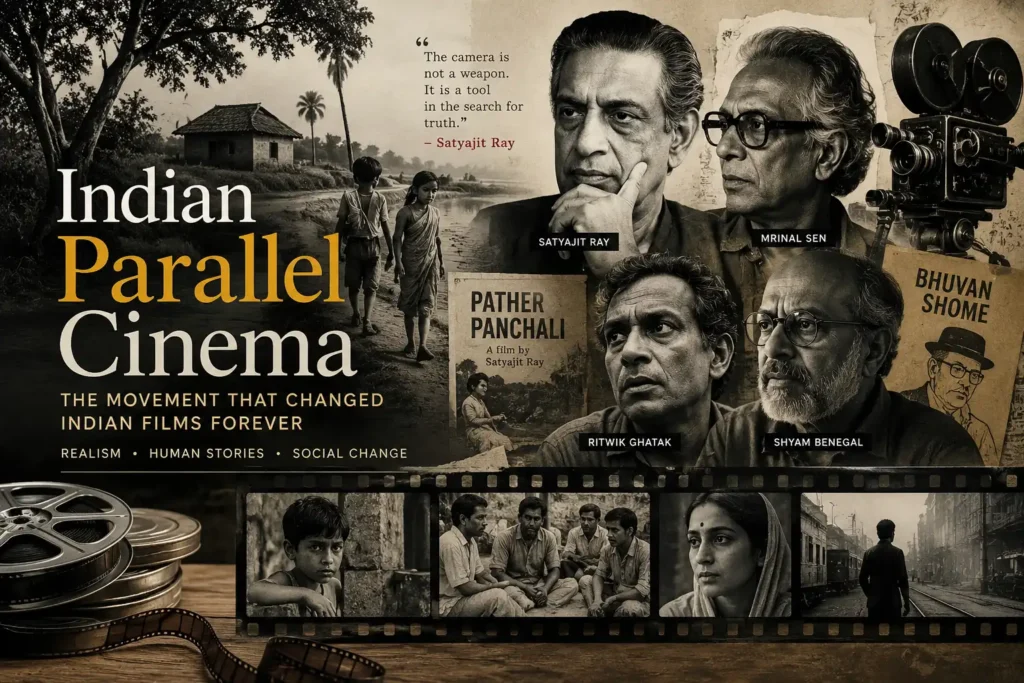
India has always been vocal about its narratives, be it through music, dance, drama, and spectacular performance. However, in the 1950s, there was another form of storytelling in India, but unlike the former ones, it lacked item numbers and larger-than-life characters. It had truth, which was the essence of Indian Parallel Cinema, a phenomenon that was bold enough to reflect upon society without any fear or hesitation.
In other words, Indian Parallel Cinema was not merely a film genre; it was a revolution within the Indian culture.
What Is Indian Parallel Cinema?
Indian Parallel Cinema refers to a filmmaking movement that emerged as an alternative to mainstream commercial cinema. It prioritised realistic storytelling, social themes, and artistic expression over entertainment formulas — running alongside Bollywood rather than competing with it directly.
While the traditional films had their stars, artificially created love stories, and dancing, Indian parallel cinema was devoid of all these aspects. It was based on reality, people’s lives, and real India, the one you could find in a village, a slum area, or an ordinary family that was gradually disintegrating.
The very name ‘parallel’ gives us a clue about its nature. Parallel cinema did not intend to substitute traditional films in any way. It existed parallelly to those films.
Origins of Parallel Cinema in India
The history of parallel cinema goes back to the period following India’s independence, a time when the country was struggling with the process of defining itself. This was an era marked by dramatic changes socially, politically, and economically. Communities had been divided due to the partition. There was poverty. The difference between rural and urban India was huge.
In Hollywood, the Italian Neorealism of directors like Vittorio De Sica, as seen in his Bicycle Thieves (1948), was gaining popularity worldwide. Here was cinema stripped off all its glamor and yet remaining extremely compelling. Indian filmmakers were very much aware of this trend.
But the origins of the parallel cinema are most definitely found in Satyajit Ray’s Pather Panchali (1955). Filmed in the rural setting of Bengal with non-professionals and on virtually no budget, the film told the tale of a poverty-stricken Bengali family with great humanity.
A Brief Timeline of Key Moments
| Year | Event |
|---|---|
| 1955 | Pather Panchali released — signals the dawn of Indian New Wave cinema |
| 1960s | Ritwik Ghatak and Mrinal Sen continue the Bengali New Wave tradition |
| 1969 | Bhuvan Shome by Mrinal Sen sparks the Hindi Parallel Cinema wave |
| 1970s | Shyam Benegal, Govind Nihalani, and Girish Karnad expand the movement nationally |
| 1975 | Shyam Benegal’s Nishant and Manthan deepen parallel cinema’s social scope |
| 1980s | Peak years of government-funded art cinema through the NFDC |
| 1990s | Economic liberalisation and satellite TV begin to erode the movement’s infrastructure |
Why Parallel Cinema Emerged in India?
It is important to consider what the mainstream cinema was not offering when trying to comprehend the emergence of the parallel cinema in India. While commercial Hindi films of the 1950s and 1960s were mostly escapist, offering entertainment and emotion, they were intentionally oblivious of harsher aspects of Indian reality.
On the other hand, many people across India were struggling with poverty, caste oppression, gender violence, and corrupt politics. Life stories of peasants, workers, women, and the urban underclass were rarely presented on the big screen. Several factors worked together to facilitate the emergence of parallel cinema:
1. International influence: Italian Neorealism and French New Wave inspired younger Indian directors to experiment
2. Government support: The Film Finance Corporation (FFC, later NFDC) began funding low-budget, artistically ambitious films
3. Film institute training: The FTII in Pune trained a new generation of technically skilled, intellectually serious filmmakers
4. Cultural urgency: Writers, artists, and thinkers felt a moral duty to engage with real social problems.
The result was a body of Indian art house cinema unlike anything the country had seen before.
Major Filmmakers of Indian Parallel Cinema
No article on parallel cinema directors is complete without looking at the visionaries who gave the movement its soul.
Satyajit Ray
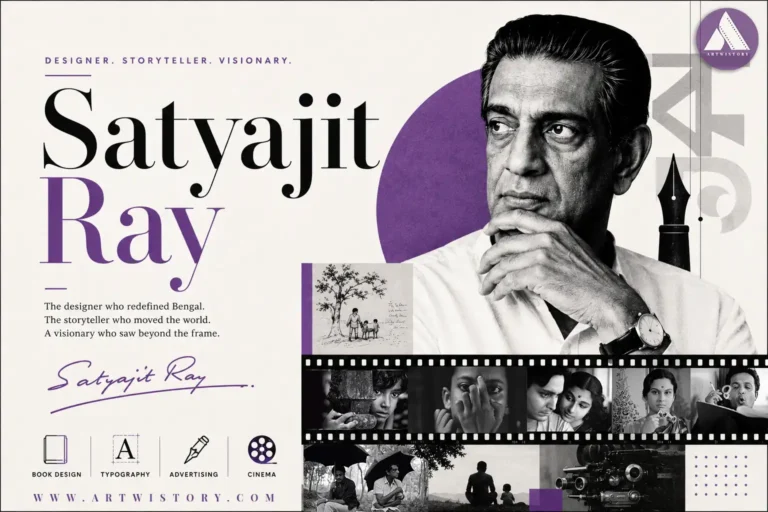
There is perhaps no other filmmaker from India who has garnered more acclaim than Satyajit Ray. The Apu trilogy, which comprises Pather Panchali (1955), Aparajito (1956), and Apur Sansar (1959), marks one of the landmarks of world cinema.
Ray’s films had their roots in Bengali cinema, yet spoke in a universal tongue. He brought to filmmaking passion, compassion, and perfection. His films never sermonized. They simply depicted things for viewers to see and feel for themselves. In recognition of his lifelong contribution to filmmaking, he was honored with an Honorary Academy Award in 1992.
Mrinal Sen
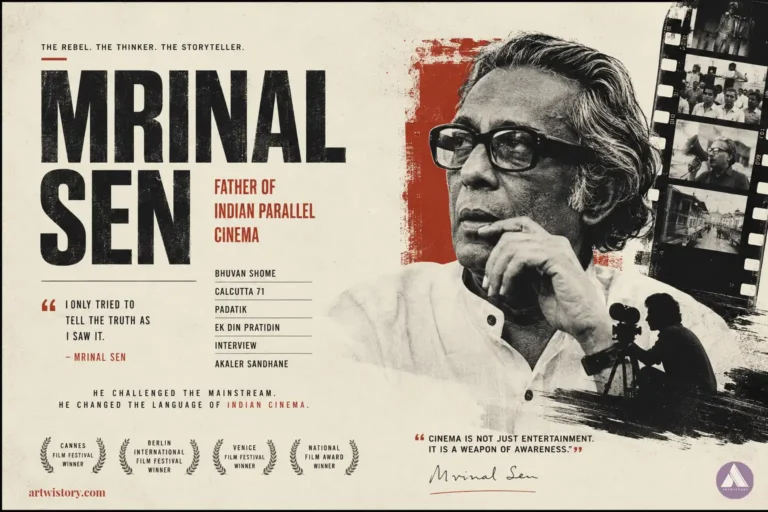
Where Ray made lyrical films, Mrinal Sen made aggressive films. His films were politically charged and aggressively Marxist. The film Bhuvan Shome (1969) is considered to be the trigger for Parallel Cinema in Hindi, which was raw and experimental and was produced by FFC.
The films from his ‘Calcutta Trilogy,’ namely Interview (1971), Calcutta 71 (1972), and Padatik (1973), deal with urban poverty and political upheavals. Sen had no liking for allegorical cinema; he preferred his cinema to be disturbing.
Ritwik Ghatak
Of the three giants of Bengali cinema, Ritwik Ghatak is perhaps the most tragic and the least understood. Films by Ghatak went mostly unnoticed while he was alive, but filmmakers who followed him would look to him as an inspiration for their work.
His films, such as Meghe Dhaka Tara (1960) and Subarnarekha (1965), brought out the pain caused by the Partition of India in a brutal and operatic style. Ghatak’s usage of sound, space, and mythology was well ahead of his time. This is not lost on people such as Martin Scorsese and Anurag Kashyap.
Shyam Benegal
While Ray, Sen, and Ghatak had created the bedrock in Bengal, Shyam Benegal went ahead and nationalized it. With his first film Ankur (1974), Benegal dealt with issues of caste and feudal oppression in rural Andhra Pradesh. The film Manthan (1976), which was funded by half a million farmers of Gujarat, two rupees each, became one of the few parallel films to garner widespread viewership.
Benegal became a mentor for an entire generation and played a role in making Indian art cinema an enduring phenomenon.
Other Notable Directors
- Govind Nihalani — Ardh Satya (1983), a searing portrait of police brutality and moral corruption
- Girish Karnad — Brought Kannada literature and mythology to the screen
- Adoor Gopalakrishnan — Led the parallel cinema movement in Kerala with Elippathayam (1981)
- Mani Kaul — Among the most formally experimental of the Indian New Wave directors
Best Indian Parallel Cinema Films
Looking for a way into the world of Indian parallel cinema films? These are the essential starting points:
| Film | Director | Year | Why It Matters |
|---|---|---|---|
| Pather Panchali | Satyajit Ray | 1955 | The film that started it all |
| Meghe Dhaka Tara | Ritwik Ghatak | 1960 | Devastating portrait of a refugee family |
| Bhuvan Shome | Mrinal Sen | 1969 | Sparked the Hindi parallel cinema wave |
| Ankur | Shyam Benegal | 1974 | Caste, power, and rural exploitation |
| Manthan | Shyam Benegal | 1976 | Grassroots India captured on film |
| Elipathayam | Adoor Gopalakrishnan | 1981 | Social stagnation through quiet allegory |
| Ardh Satya | Govind Nihalani | 1983 | Police, power, and moral failure |
| Sparsh | Sai Paranjape | 1980 | A tender story of disability and dignity |
Difference Between Parallel Cinema and Bollywood
One of the most frequent questions posed by people in this context is the following, which does not have an easy answer since it cannot be simply categorized as a comparison of good or bad cinema. Parallel cinema and commercial cinema are not concerned with being better or worse.
| Parallel Cinema | Bollywood / Commercial Cinema |
|---|---|
| Rooted in realism | Often aspirational and escapist |
| Low budget, minimal glamour | High production values, star-driven |
| Social and political themes | Romance, action, family drama |
| Slow pacing, literary style | Fast-paced, entertainment-focused |
| Festival circuit distribution | Mass theatrical release |
| Government / NFDC funded | Studio or producer funded |
But it should also be mentioned that the line has always been blurry too. Socially conscious movies were being made even by directors such as Bimal Roy (Do Bigha Zamin, 1953). Parallel filmmakers like Naseeruddin Shah and Shabana Azmi have also made commercial films.
How Parallel Cinema Influenced Modern Indian Films?
The impact of Indian Parallel Cinema in today’s films is great, even when it is not being acknowledged. The likes of Anurag Kashyap (Gangs of Wasseypur, 2012) and Vishal Bhardwaj (Omkara, 2006) openly state that Parallel Cinema was instrumental in shaping their approach towards filmmaking.
In addition, the advent of OTT channels has also opened up a whole new platform for content that reflects many characteristics of Parallel Cinema. Examples of shows that follow in its footsteps include Panchayat, while films such as Court (2014) and Newton (2017) are clear examples of how influential it has become.
Parallel Cinema has even found its way into mainstream Bollywood films. For instance, movies like Taare Zameen Par (2007) and Dangal (2016) tackle societal problems within mainstream films – a rare occurrence prior to Parallel Cinema establishing that genre of filmmaking.
Why Parallel Cinema Declined?
The end of parallel cinema in India didn’t happen all of a sudden. Rather, it took place through the gradual erosion caused by different factors.
Liberalization in 1991 brought a huge change to Indian consumer behavior. There were satellite channels and multiplex cinemas. The upper-middle-class consumers needed entertainment rather than any social criticism. NFDC, which funded all parallel cinema, stopped supporting it. As there was no funding available, art movies couldn’t compete with commercial movies in terms of screening and audience.
Furthermore, there was also a generation of new filmmakers who could manage to merge realism with entertainment. Thus, the distinction between those two became blurred. There was even a problem of exhaustion since parallel cinema created its own conventions and predictability.
Is Indian Parallel Cinema Still Alive Today?
Yes — and arguably more alive than it’s been in decades. Indian independent cinema today finds its audience through international film festivals, streaming platforms, and a global diaspora hungry for stories beyond Bollywood. The spirit of the movement is very much alive; it just wears different clothes now.
Films like Masaan (2015), Aligarh (2016), Thappad (2020), and The Great Indian Kitchen (2021) carry forward the parallel cinema tradition — socially urgent, humanly specific, artistically serious. Regional language cinema from Kerala, Tamil Nadu, and Maharashtra has been especially strong.
Key Takeaways
- Indian Parallel Cinema emerged in the 1950s as a reaction to the escapist mainstream film industry and international neorealism trends
- Satyajit Ray’s Pather Panchali (1955) is regarded as the starting point for the movement
- The movement was maintained through governmental financing through the FFC and later the NFDC
- Major directors in the movement were Satyajit Ray, Mrinal Sen, Ritwik Ghatak, Shyam Benegal, and Govind Nihalani
- The movement became defunct in the 1990s due to economic liberalization, satellite television, and decreased governmental funding
- The impact of this movement can be seen even now in Indian films, including Bollywood films, regional films, and OTT
- Indian independent film continues the tradition of Indian Parallel Cinema
Conclusion
Indian Parallel Cinema has never been just about cinema itself. This was a philosophy that resisted all commercial pressure, choosing to address the harsh realities of Indian life rather than ignoring them.
This is where we saw some of the best movies of all time produced. We saw new generations of directors, actors, and filmmakers come up through the ranks and create their own cinematic legacy. More importantly, we were shown once and for all that audiences can handle the intricacies of artful storytelling.
Indian Parallel Cinema may have ceased to exist in name. However, its essence remains present in the best Indian cinema today.
If you have never seen any movie of the parallel cinema genre, I suggest that you begin with Pather Panchali. It will take only twenty minutes for you to realize how this phenomenon revolutionized Indian movies – and this rabbit hole is definitely worth entering.
The Indian Parallel Cinema movement is one of the movements in film that was born in the 1950s as a reaction against mainstream films. The movement embraced realistic approaches, addressed social problems, and employed artistic narration techniques that were not intended to entertain.
The movement is generally traced to 1955, when Satyajit Ray released Pather Panchali. It gained momentum through the 1960s and reached its peak in the 1970s and 80s with directors like Shyam Benegal and Govind Nihalani.
Parallel cinema evolved since mainstream cinema failed to take into account the lives of Indians, which revolved around poverty, caste, sexual abuse, and the politics of corruption. Filmmakers influenced by Italian Neorealism and with help from government funding found a moral responsibility to depict such tales.
The most celebrated directors include Satyajit Ray, Mrinal Sen, Ritwik Ghatak, Shyam Benegal, Govind Nihalani, Adoor Gopalakrishnan, and Girish Karnad. Each brought a distinct sensibility and regional perspective to the movement.
The parallel film movement focuses on realism and social issues, while Bollywood is more inclined towards escapism and entertainment. However, this difference has never been as clear-cut as one may think.
The downfall mainly occurred during the 1990s owing to factors such as economic liberalization, satellite television, emergence of multiplex cinema, and lower government support. In addition, the sharp distinction between art films and commercial cinema was also blurred as the directors from mainstream cinema took cues from realism.
Very much so. Contemporary films like Masaan, Thappad, and The Great Indian Kitchen continue the tradition. OTT platforms have also revived space for socially serious storytelling that echoes parallel cinema’s core values.