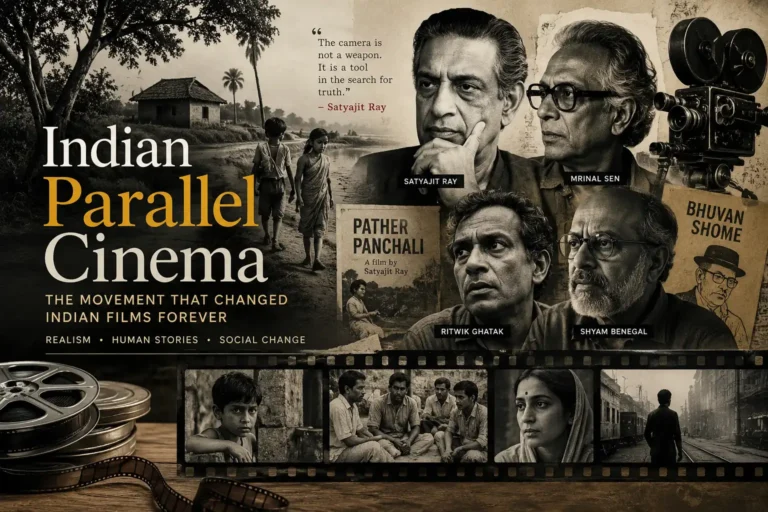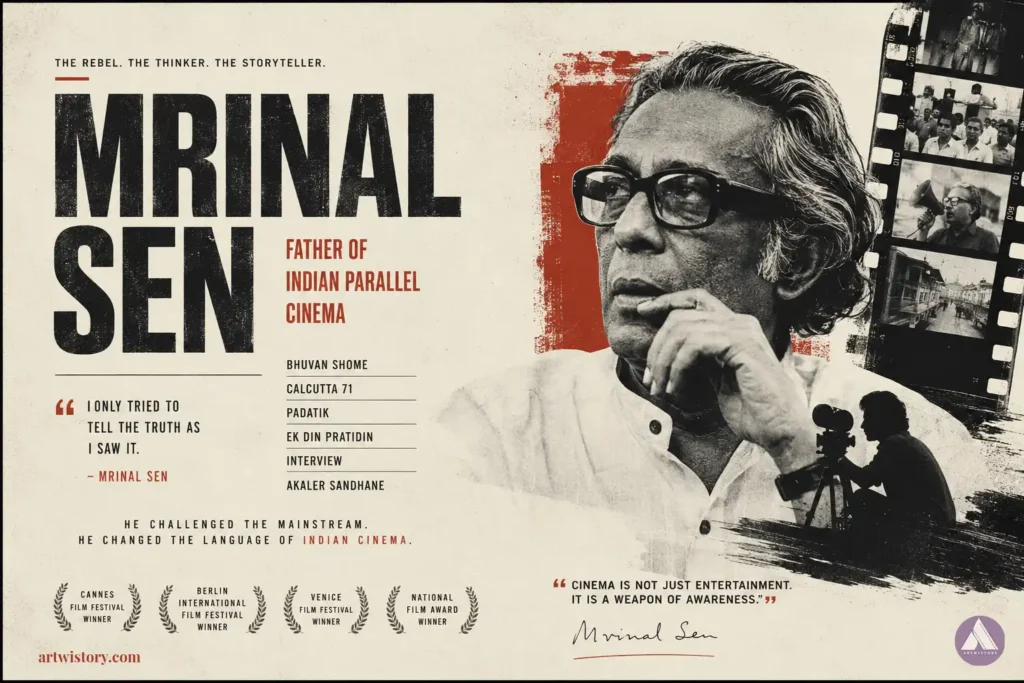
Everyone who knows anything about Mrinal Sen, the famous rebellious Bengali director of Cannes, Berlin, and Venice award-winning movies, who stood up against the system and gave rise to Indian parallel cinema, knows all the legends.
However, only a handful of people know the story of how the great man stood in the nude in an obscure hotel in Jhansi, staring at himself in a mirror and pulling strange faces until he broke down and sobbed like a child.
Mrinal Sen had not revealed his secret for almost 18 years.
Then, he chose to tell it to none other than the legendary Indian actor Utpal Dutt, whom he met on a film set, readying for what was supposed to be the greatest moment of his career. The consequences of this were some of the most brilliantly subtle scenes in the history of Indian cinema.
Who Was Mrinal Sen Before He Became Mrinal Sen?
But before getting to the hotel room in Jhansi, let me tell you about the man who found himself in that place.
Born on 14th May 1923 in Faridpur in present-day Bangladesh, Mrinal Sen migrated to Kolkata in the 1940s to study physics in Scottish Church College. And like any other intelligent, restless youth of that time, he was soon captivated by the power of ideas – Marxist politics, literature, drama, and finally, cinema.
He came into contact with a group of very smart young intellectuals who used to have adda sessions around Basusree Cinemas of Kolkata – some of them being Ritwik Ghatak, Salil Chaudhury, and Tapan Sinha – a group of youth who were politically conscious and completely sure that Indian cinema can be so much more than what it actually was.
Mrinal Sen read a lot of things: books like Eisenstein’s Film Form, Rudolf Arnheim’s Film as Art, Vladimir Nilsen’s The Cinema as a Graphic Art, and many such. He even wrote several essays on the aesthetics of films, like one who knew how it was done.
Only he didn’t.
What Happened When Mrinal Sen Made His First Film?
But in 1955, Mrinal Sen completed his first film, Raat Bhor (The Dawn). He had discussed cinema endlessly. He had argued about its form and politics and aesthetics until three in the morning in the tea shops of Calcutta. He had studied every great filmmaker.
And he despised his own creation.
“As far as I was concerned,” he explained later, “the problem wasn’t just deciding what to say, because I didn’t know how to say it.”
Humbled — and this is the precise word that he used – Mrinal Sen abandoned filmmaking and found work as a medical representative at a pharmaceutical firm in Kanpur. He filled his suitcase with samples of the company’s products, rode the trains into smaller towns, met politely with doctors and pharmacists, and hoped that he would soon forget that he had once considered himself an artist.
Five months went by. Nothing had changed about the job, or about Mrinal Sen. Underneath his professional demeanor and salesmanship, he remained a man consumed with a passion for making films, and slowly losing his mind from lack of doing so.
The Night That Changed Everything: The Jhansi Hotel Room
And then there was his usual business trip to Jhansi.
In the evening, Mrinal Sen went back to his hotel room. He gazed into himself in front of the tall mirror. He saw the man in front of him, who used to take pages upon pages to write down theoretical musings on cinema and had fought bitterly with other intellectuals over the relative merits of Eisenstein and Pudovkin, drinking tea in Calcutta, who was now working to sell medicine in a city where nobody understood his language.
All that followed is captured in his own memoirs, “Always Being Born” (Stellar Publishers), which is possibly one of the most honest accounts of its kind written by any Indian director. He started addressing himself in the mirror, “So, here you are, Mrinal Sen, who did plenty of reading on cinema, wrote much on its aesthetics, and desperately tried to impress people!”
And then, in an outpouring of something far beyond self-pity, he stripped himself naked of all his clothes. There he stood, in the nude, staring at himself in a hotel room in Jhansi. He pulled faces. He spoke nonsense words, speaking Bengali, Hindi, any language that came to mind. He gesticulated violently. And he yelled.
He cried, too, sobbing like a little boy utterly alone in the middle of nowhere.
Three days later, he sent a lengthy telegram to his management offices in Bombay.
He quit.
He went home to Kolkata. He went back to the cinema. And he never looked back.
How Did Mrinal Sen Build Indian Parallel Cinema After Walking Away?
The years to come would be difficult, as all good battles are.
In the 1950s and 60s, Mrinal Sen made films that were critically well-received, yet largely neglected by audiences. Neel Akasher Neechey (1959), Baishey Sravana (1960), Punascha (1961) — they all served as stepping stones in his career, yet none of them succeeded. Matira Manisha (1966) in the Oriya language, which was neither a commercial success nor helped him make friends with Bengali producers.
By 1968, the future star of parallel cinema was stranded in Calcutta, penniless and unable to make a single film due to the lack of funding and producers.
That’s when help arrived out of the blue, and we returned to the secret he had kept from everyone after Jhansi.
What Is the Story Behind Bhuvan Shome — and Why Does It Matter?
An offer was extended to the filmmaker by the Film Finance Corporation, now known as NFDC, to make a movie at the modest budget of ₹1.5 lakh. The movie Bhuvan Shome was released in 1969.
Bhuvan Shome narrated the tale of a humorless, inflexible bureaucrat, Mr. Shome, who undertakes a duck hunting trip to Saurashtra, where he meets a carefree village girl who takes away his emotional guard. A comedy, a satire, and a revolution in Indian cinema.
As Utpal Dutt, the Bengali theatre actor par excellence, was cast to play the role of Mr. Shome, it was the actor’s first foray into Hindi films. Bhuvan Shome also marked the debut performance of actress Suhasini Mulay in her first film ever – not to mention that it was the first time young actor Amitabh Bachchan made money as a narrator for the film.
What was special about Bhuvan Shome is that there were no sets, no stars, no songs, no happy ending. It flouted all the conventions of Bollywood. However, it was accepted by the Film Finance Corporation partly because, as mentioned by Indira Gandhi, then the Minister of Information and Broadcasting: “At such a low cost, we can give him a chance.”
The Scene That Almost Didn’t Happen — And the 18-Year-Old Secret That Saved It
The shoot went on. But then Mrinal Sen faced an obstacle.
In one scene that Mrinal Sen wanted to capture – one that marked the apex of the film’s plot, as it were – Bhuvan Shome comes back from his experience of growth in the countryside into the world of his bureaucratic life, only to discover with quiet horror that absolutely nothing has changed: he is the same man, a rigid, duty-bound, and lonely individual. No tragedy. No melodrama. Just a silent and chilling realisation.
Mrinal Sen could not explain what needed to be conveyed in that particular scene. How do you explain such an emotional moment that cannot really be conveyed from the outside?
Therefore, Mrinal Sen took Utpal Dutt into a separate room. He showed him a different side of Jhansi.
Jhansi.
A hotel room. The bathroom. The strip-down. The faces. The shouting. The crying. The telegram. The resignation. The whole embarrassing and shattering experience that Utpal Dutt went through 18 years before in 1951, of which he had told no one else but Mrinal Sen.
As Utpal Dutt listened, he remained utterly silent. When Mrinal Sen concluded his story, Dutt put his hand on Mrinal Sen’s shoulder and simply said these four words:
“Give me ten minutes.”
He left the scene. Mrinal Sen and the entire cast and crew waited.
After ten minutes, he came back and filming resumed.
The sequence that was eventually filmed remains even today one of the most memorable scenes in the annals of Indian parallel cinema – a scene crafted solely out of the revelation of a secret that the young salesman had harbored all by himself inside his heart ever since an insomnia-filled night in Jhansi.
What Impact Did Bhuvan Shome Have on Indian New Wave Cinema?
The influence of Bhuvan Shome on the Indian New Wave was simply enormous.
According to the reports produced by the Film Finance Corporation itself, the development of Indian film financing could be traced through two periods: before Bhuvan Shome and after Bhuvan Shome. The film was the trigger that opened up the finances of an entire generation of independent directors: Shyam Benegal, Adoor Gopalakrishnan, Girish Kasaravalli, Kundan Shah, and Ketan Mehta.
After Bhuvan Shome Mrinal Sen created such landmarks of Indian parallel cinema as Ek Din Pratidin (1979), Akaler Sandhane (1980), which took the Silver Bear at the Berlin International Film Festival, and Kharij (1982), which was awarded the Special Jury Prize at the Cannes Festival in 1983. He has received 18 National Film Awards and a Padma Bhushan during his career and was named the Commandeur de l’Ordre des Arts et des Lettres in France.
The director from Bengal, who wept naked in a Jhansi hotel room, became the first Indian film-maker to be rewarded with major prizes at all three major world film festivals: Cannes, Berlin, and Venice.
What Did Mrinal Sen Say About Himself That Explains Everything?
There is a line Mrinal Sen wrote in Always Being Born that explains perhaps better than anything else why that night in Jhansi was not a breaking point but a beginning point.
“I am a filmmaker by accident and an author by compulsion.”
He described himself as a “private Marxist” — different from party Marxists, he said, because “others think they have pocketed the truth, whereas I am always in search of truth.”
In the Jhansi hotel room in 1951, the man was not faltering; he was being truthful — to himself, in the rawest sense imaginable. And it was precisely because of that truthfulness, that openness to taking oneself apart both figuratively and literally, that all that the man would create over the following 60 years got its impetus.
When Mrinal Sen shared the anecdote with Utpal Dutt in front of the camera on the film sets of Bhuvan Shome, he was not merely providing his actor with some emotion cues. What the director did was much more important than that; he was imparting to the actor what he himself valued most in life: ruthlessness in being truthful to oneself.
The Legacy: Why This Story Still Matters Today
Mrinal Sen died on 30 December 2018 in his residence at Bhawanipore, Kolkata. He was 95.
According to Kunal Sen, the son of Mrinal and actress Gita Sen and author of the book “Bondhu” which describes his relationship with both his parents, Mrinal Sen was, despite everything he showed on screen, an “exceptionally humorous person.”
No better summary of this man can be found in the story of the Jhansi hotel room. It is humorous, but also excruciatingly painful, and completely, unapologetically naked in its nature. And in the end, it created a cinematic moment that people are still witnessing even decades later.
What gave birth to the Indian New Wave era, and specifically to the parallel cinema movement led by Mrinal Sen, was not any brilliant idea conceived while filming on a movie set. It was born from a moment of utter humiliation felt by one man in a ₹50 hotel room in Jhansi, and willingness 18 years later to share that humiliation with the person who really needed to know about it.
That is Indian parallel cinema in a nutshell.
That was Mrinal Sen.
Mrinal Sen’s autobiography is titled Always Being Born, published by Stellar Publishers. It contains the famous account of the Jhansi hotel room episode, among many other candid reflections on his career and personal life.
Mrinal Sen is best known as one of the pioneers of Indian parallel cinema and the Indian New Wave movement. His most celebrated films include Bhuvan Shome (1969), Ek Din Pratidin (1979), Akaler Sandhane (1980), and Kharij (1982).
Bhuvan Shome (1969) is widely regarded as the film that launched the Indian New Wave. The Film Finance Corporation (FFC) officially referred to history in terms of “a pre-Bhuvan Shome period and a post-Bhuvan Shome period.” It influenced a generation of Indian parallel cinema directors and gave Amitabh Bachchan his first paid work in cinema as a voice-over artist.
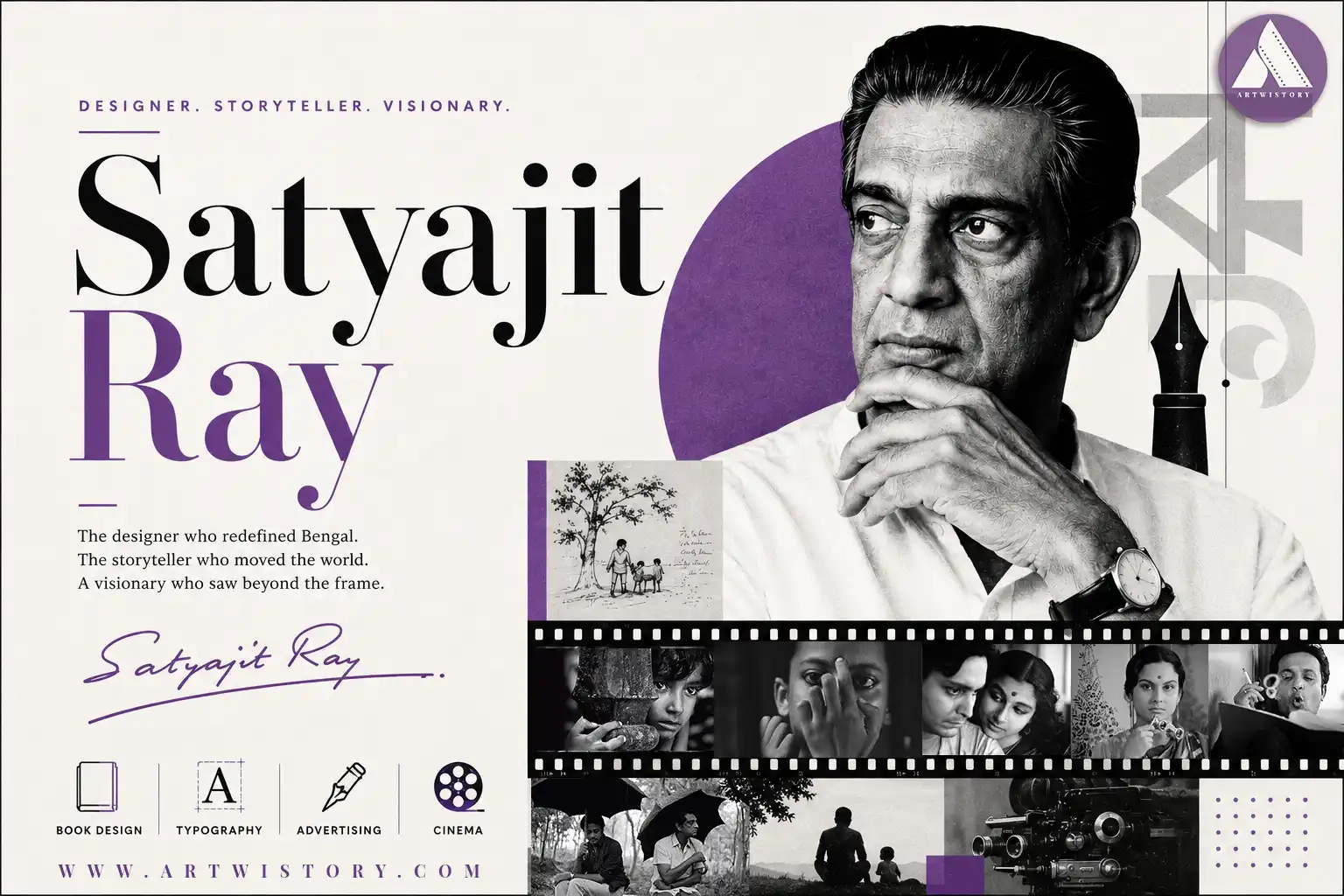
They were peers more than rivals, though their philosophies of cinema differed sharply. Satyajit Ray’s unit of social analysis was the individual; Mrinal Sen’s was class. Both began their film careers in the same year. They are regarded, along with Ritwik Ghatak, as the defining trio of Bengal’s golden age of cinema.
Mrinal Sen won 18 National Film Awards, the Dadasaheb Phalke Award (2005), the Padma Bhushan (1983), and France’s Commandeur de l’Ordre des Arts et des Lettres. His films won the Silver Bear at Berlin, the Special Jury Prize at Cannes, and awards at Venice — making him the only Indian filmmaker to have won major prizes at all three of the world’s top film festivals.